
When Buildings Push Back: How Wind and Stack Effect Impact Commercial Entrances
In a city skyline, the tallest buildings don’t feel like they’re standing still, they’re always responding to the shifting movement of air around them. Towering glass structures rise into constantly shifting air, where wind moves between streets, wraps around corners, and funnels through tight corridors between skyscrapers.
An entry door must respond to changing pressure conditions every time it’s used. The right solution can help manage these forces instead of fighting them, improving usability, reducing strain on hardware, and ensuring reliable performance in the most demanding environments.
Custom balanced doors were specifically engineered to solve this challenge for commercial buildings.
Understanding Wind Pressure and Stack Effect
You don’t see it. You don’t hear it. But every time you open a door, the effects are felt. Wind pressure and shifting air currents are constantly at work around and inside buildings, influencing how its doors move and perform.
As external air moves across a structure, it creates uneven zones of high and low pressure that can push or pull on a door, affecting how easily they open, close, and latch.
At the same time, buildings experience stack effect, or the natural movement of air caused by temperature differences between indoor and outdoor environments. Warm air rises and escapes through upper portions of the structure, while cooler air is drawn in at lower levels. This creates a slow but constant vertical airflow and pressure imbalance throughout the building.
Together, wind pressure and stack effect can place significant stress on door systems. In high-rise buildings, healthcare facilities, schools, airports, and other large structures, these forces can make doors difficult to operate, compromise accessibility, and increase wear on hardware over time.
The Challenge of Traditional Doors
Traditional swing doors are constantly going head-to-head with these forces that exist in every built environment. When it comes to pressure differentials, the larger the door, the more force it experiences and the harder it is to open.
HVAC systems, elevator shafts, wind exposure, and even people moving throughout the building all contribute to shifting air currents and changing conditions. And, unlike automated or pressure-balanced systems, traditional doors rely primarily on hinges, closers, and the user’s physical force to overcome these changing conditions. As a result, doors may become difficult to operate, fail to close consistently, or slam shut under sudden pressure changes.
Finding the Balance
Balanced doors address these challenges by working with the forces inside and outside of a building, not against them. Rather than relying solely on hinges and manual force to overcome resistance, a balanced door’s design allows for airflow on both sides of the door leaf by relocating its pivot point. This matters when wind pressure, stack effect, and internal air movement are all in flux. In those conditions, a traditional swing door can feel heavy one moment, unstable the next, or unpredictable as airflow conditions change in real time. Balanced systems provide much more consistent performance by neutralizing much of the resistance before it ever reaches the user.
In Action: Windy Conditions at Texas A&M
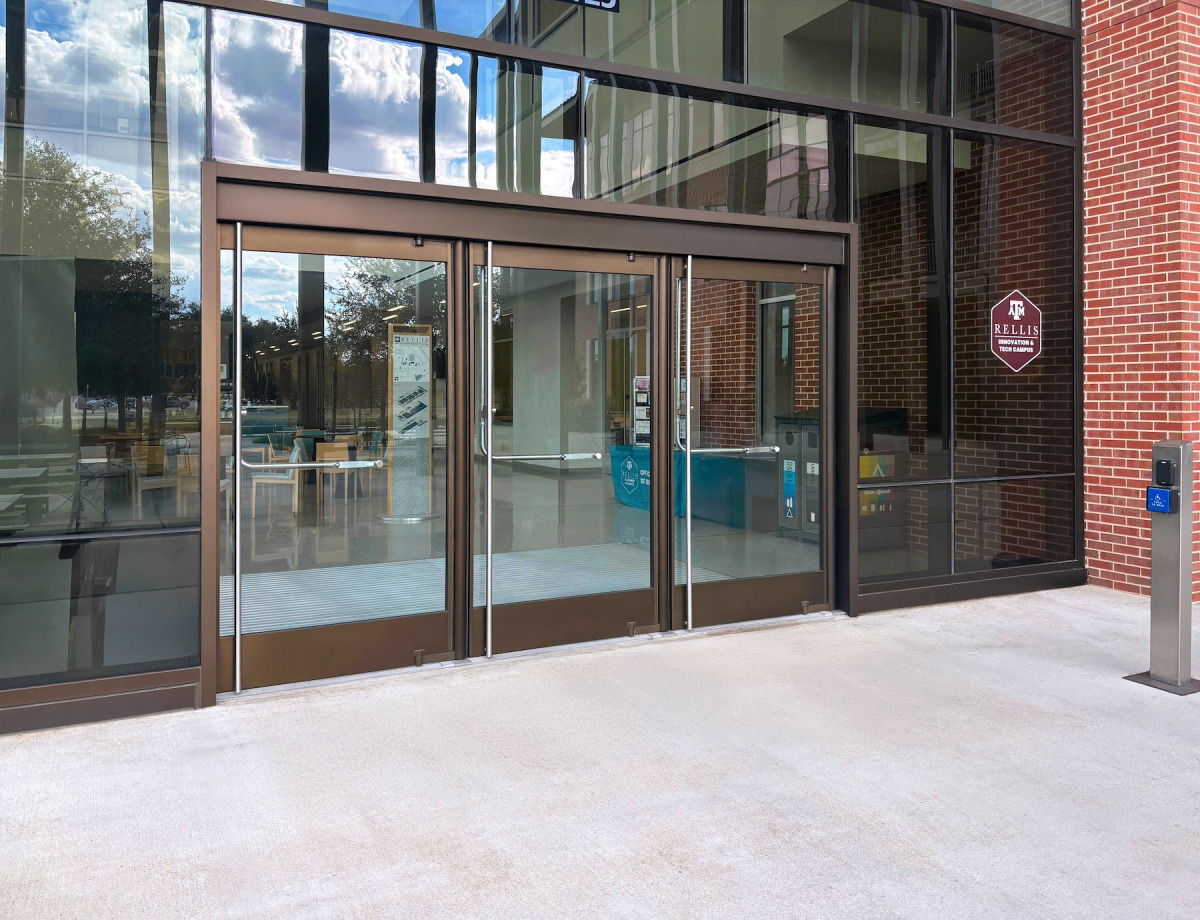
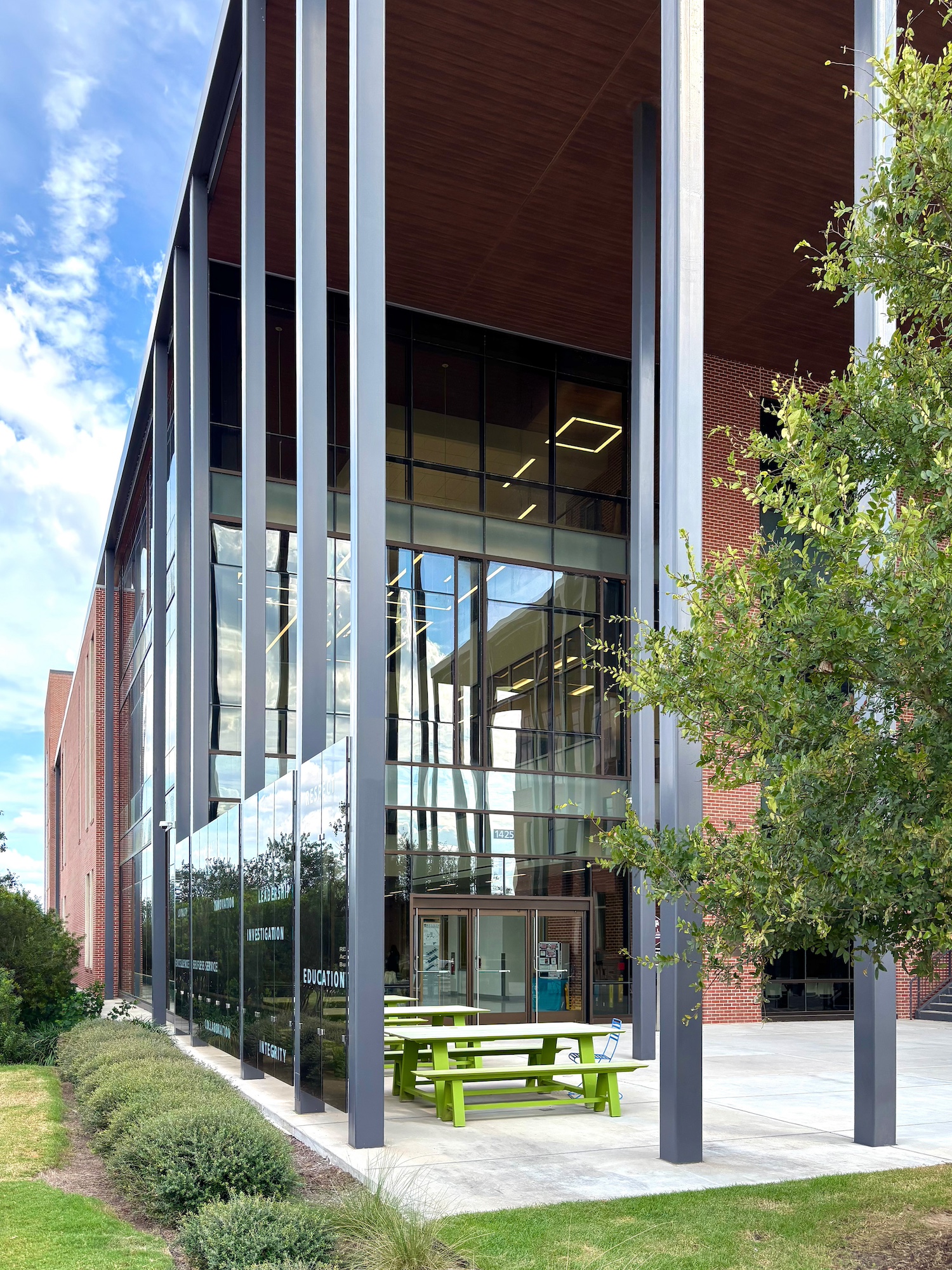
That reality became clear at Texas A&M RELLIS, where demanding building conditions exposed the operational limits of conventional door systems.
The building’s orientation subjected entrances to sustained wind that increased opening resistance beyond typical expectations. At the same time, stack effect intensified internal air pressure differences throughout the structure, compounding the force acting on the doors from both sides. These loads created conditions where the installed standard swing doors struggled to operate reliably, as the pressure differential continuously worked against the opening motion. Ultimately, the wind tunnel was so strong that the original doors were ripped from their hinges.
The project illustrates a key design reality in commercial buildings: wind can have a considerable impact on entry doors, and it rarely acts alone. When paired with stack effect, the resulting conditions can significantly increase operational stress on entry systems, particularly in tall buildings.
In the case of Texas A&M’s RELLIS campus, the environmental conditions required a system capable of balancing those opposing forces rather than simply resisting them, demonstrating how entry design must account for the full environment, not just exterior wind loads in isolation. To address these demands, the project architects selected balanced doors from Ellison Bronze
Designed for Demanding Environments
As modern buildings become larger and more complex, these pressure-related issues are showing up more often at main entryways. The Texas A&M RELLIS project demonstrates how quickly wind and stack effect can turn a standard doorway into a daily operational challenge, and why accounting for those forces early in the design process is critical to long-term door performance.
Architects worldwide turn to balanced doors to solve this specific challenge. Their design allows large entry systems to operate with greater control and consistency under demanding conditions, helping maintain accessibility, occupant comfort, and reliable day-to-day performance.

AIA Continuing Education
Receive 1 AIA CES HSW/SD credit hour through our new online course.